Video
video plays the app's single platform-decoded video through the media-surface texture channel: on macOS, AVFoundation decodes straight into the compositor while your app core sees only commands and journaled events — pixels never cross the model boundary. Hosts without a decoder yet (Windows and Linux today) report the capability honestly and answer a load with one explicit failed event, never a silent stub.
src declares the source — an app-assets path, or an http(s) URL streamed progressively — resolved local-first, exactly like audio. Declaring a src loads the player (a changed src replaces the playback whole; one player is the whole surface); autoplay (the default), loop, and muted shape the fresh playback.
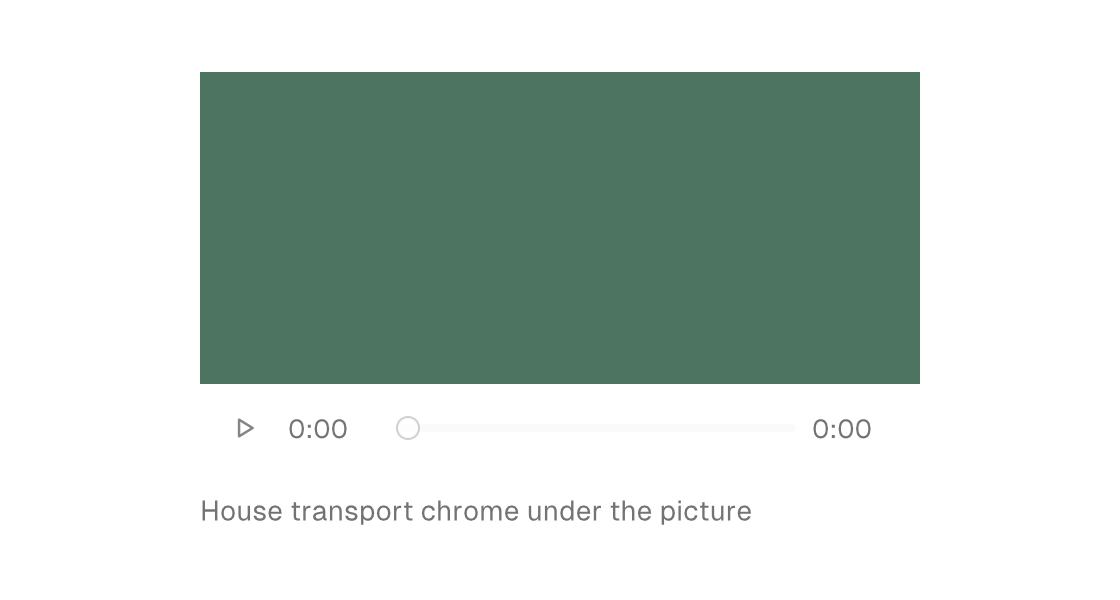
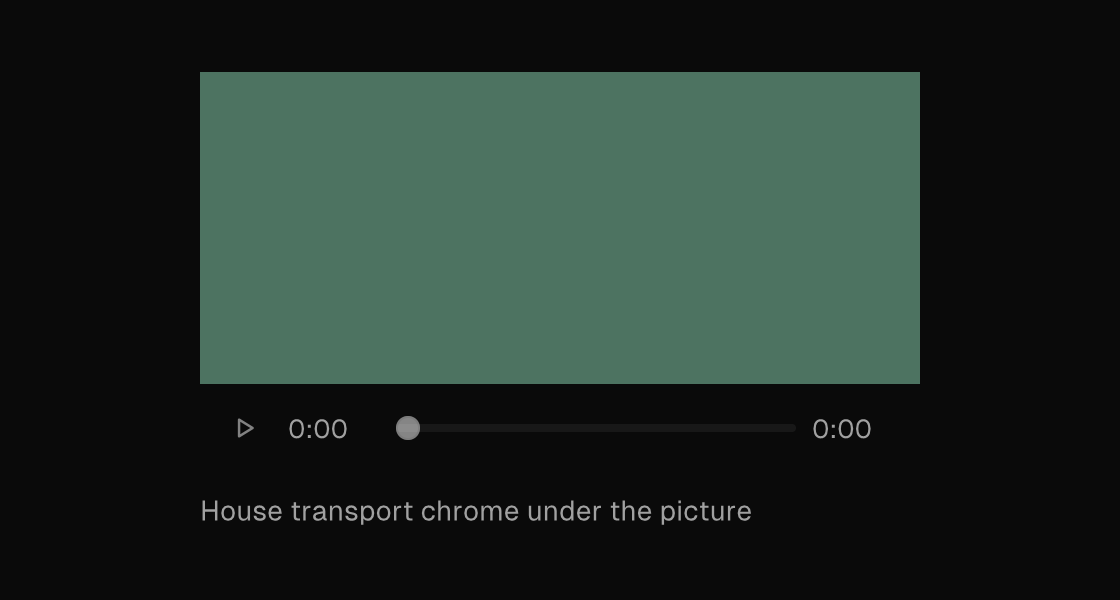
controls composes the house transport chrome under the picture: a play/pause button, a scrub slider, and elapsed/duration readouts — runtime-driven, so your model carries no transport state at all. Without controls the element is the surface alone: compose your own controls from the video command vocabulary (Cmd.videoLoad/videoCtl in TypeScript, fx.loadVideo and the transport verbs in Zig), the audio pattern.
Until a decoded frame arrives — and in every golden, reference screenshot, and session replay — the surface shows its deterministic id-derived placeholder: texture contents are presentation chrome by policy, while the transport (loaded dimensions and duration, position ticks, buffering, completion, failures) is journaled truth that replays byte-identically with no decoder behind it.
Markup
<column gap="10">
  <video src="assets/clips/launch.mp4" controls height="200" label="Launch clip" />
  <video src="{model.trailerUrl}" autoplay="false" muted height="200" label="Trailer" />
</column>
The element is a leaf (no children) with no intrinsic size — give it definite width/height or flex grow, and a label for screen readers (the image rule).
Programmatic construction (Zig)
ui.video(.{
    .src = "assets/clips/launch.mp4",
    .controls = true,
    .height = 200,
    .label = "Launch clip",
})
Custom controls
Bare <video src> plus your own chrome is the audio pattern end to end: transport events arrive as ordinary messages, and the transport verbs drive the same single player the element loaded.
// update
.toggle_play => if (model.playing) fx.pauseVideo() else fx.playVideo(),
.scrubbed => |fraction| fx.seekVideo(@intFromFloat(fraction * @as(f64, @floatFromInt(model.duration_ms)))),
See the video-player example for a complete player at both tiers — house chrome on one screen, custom controls on another.
Attributes
| Attribute | Description |
|---|---|
src | video: the source string — an app-assets path (tried first as a local file) or an http(s) URL (streamed progressively when the local file is absent), a literal or one {binding}. Declaring it loads the app's SINGLE video player (a changed src replaces the playback whole); omit it to render the surface alone over a playback your update code drives. |
controls | video: composes the house transport chrome under the picture — play/pause, a scrub slider, and elapsed/duration readouts, runtime-driven so the model carries no transport state. Omit it for the bare surface and compose your own controls from the video command vocabulary. |
autoplay | video: start playing as soon as the load lands (the default). false loads paused at the first frame — the poster shape; play resumes it. |
loop | video: wrap from the natural end back to the start and keep playing. A looping playback never delivers a completed event — it never ends. |
muted | video: start with the audio track muted (a reversible switch, independent of the remembered volume). |
width | Definite width (plain number): the element is exactly this wide (no intrinsic size). |
height | Definite height (plain number): the element is exactly this tall (no intrinsic size). |
grow | Flex grow factor. |
label | Accessible name for the picture (the image rule: unnamed video degrades to an unnamed image for screen readers; label="" marks it decorative). |
key | Sibling-scoped identity key. |
global-key | Parent-independent identity: ids survive reparenting between containers. |